

Dough School
From choosing flour to balling: hydration, salt, yeast, fermentation and kneading explained step by step, with numbers you can follow.
21 guides in this hub
Neapolitan pizza dough is four ingredients – flour, water, salt and yeast – and a lot of small decisions. The Dough School takes them one at a time: how much water, how much salt, which yeast, how long the dough should rest and at what temperature, and how you can tell it is ready.
If you are new, start with the complete Neapolitan pizza dough recipe, then read up on hydration and cold fermentation. When the numbers start to make sense, baker’s percentage is what ties them together. Every guide says whether a number comes from AVPN, from established baking science or from our own house method.
Guides on this topic

Start here · 3 min
Biga or poolish – chewy rim or airy crumb
Biga is dry and builds chew; poolish is wet and opens up the crumb. Hydration, yeast and timing for both, and how to choose between them.
Read the guide
Bulk fermentation – the three signs it’s time to divide
3 min
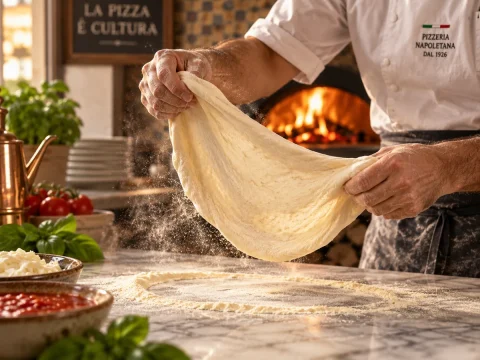
72-hour cold fermentation – deepest flavour, highest flour demands
3 min

48-hour cold fermentation – the house method’s standard
3 min
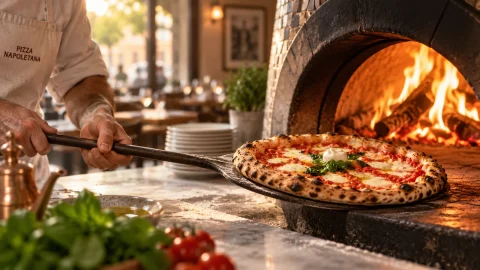
24-hour cold fermentation – the short, forgiving option
3 min
Quick pizza dough – when there was no time to ferment
2 min
More to read

Guide · 2 min
Dough temperature – the number most people skip
A finished dough at 23 °C ferments the way the recipe says; at 28 °C it won't. How to work out the water temperature from flour, room and mixer.

Guide · 1 min
Sourdough pizza – Neapolitan dough without baker’s yeast
Levain percentage, hydration and a schedule for a cold sourdough ferment. How to tell when your starter is ready and how to avoid a sour aftertaste.

Guide · 1 min
Poolish – a wet preferment for an airy dough
Poolish is equal parts flour and water plus a pinch of yeast. How to make it, what a ready poolish looks like and how to build the dough from it.

Guide · 2 min
Biga – a stiff preferment for a chewier crust
Biga brings aroma and a crust with real chew. Here is the schedule for 50, 70 and 100% biga, with times and temperatures suited to home kitchens.

Guide · 2 min
Balling – weight, technique and the tray they rest in
An even ball is half the stretching. Two techniques step by step, why 250 g is weighed rather than guessed, and how the balls should rest while they ferment.

Guide · 2 min
Baker’s percentage – calculate dough like a pizzaiolo
Once you understand baker's percentage, you can scale any recipe to the amount you need. A worked example using our 65% house dough, step by step, in grams.

Guide · 1 min
Autolyse – half the kneading for free
Flour and water rest without salt or yeast, and the gluten forms on its own. How long to wait, what actually happens, and when autolyse is simply unnecessary.

Guide · 2 min
Gluten in pizza dough – what builds it and what ruins it
Why the same recipe turns floppy with one flour and springy with another. The gluten network explained, with the windowpane test and what builds or ruins it.
Guide · 2 min
Kneading – by hand or machine, and when to stop
How long to knead by machine and by hand, how the dough feels when it's done, and why dough overworked in a fast mixer turns grey and never quite recovers.
Guide · 2 min
Room-temperature fermentation – same-day dough without skimping on flavour
No space in the fridge or no patience? How to adjust the yeast for 6–8 hours at room temperature and keep the dough from running away from you.
Guide · 2 min
Salt in pizza dough – how much and why
2.8% salt isn't just about taste – it puts the brakes on fermentation. How much goes in, when it goes in and what happens if you forget it, step by step.
Guide · 2 min
Cold fermentation – why the fridge makes better dough
The fridge adds flavour and flexibility, but only if your flour holds up. How to plan 24, 48 and 72 hours at a normal fridge temperature of 4–8 °C.
Guide · 2 min
Fermentation – time, temperature and how to tell the dough is ready
A table of proofing time against temperature and yeast quantity, plus a visual guide to what a ready, underproofed and overproofed dough ball looks like.
Guide · 3 min
Yeast in pizza dough – fresh, active dry or instant
How little yeast you really need, how to convert between fresh, active dry and instant, and why many everyday recipes contain twenty times too much.
Guide · 2 min
Pizza dough hydration – from 58 to 75 %
How much water can your dough take? A table linking hydration to your flour's W value and your oven's temperature, with advice for each level, gram by gram.